Comparison · updated August 5, 2026
Honeydue vs. Goodbudget: two ways to share a budget
One watches household money together. The other decides where it should go first.
Honeydue beats Goodbudget narrowly in 2026, 4.8 to 4.5. Choose Honeydue for free connected-account visibility, flexible partner privacy, and easier daily coordination. Choose Goodbudget if both people want to fund digital envelopes before spending. The winner depends less on features than on whether your household needs a shared rearview mirror or a shared map.
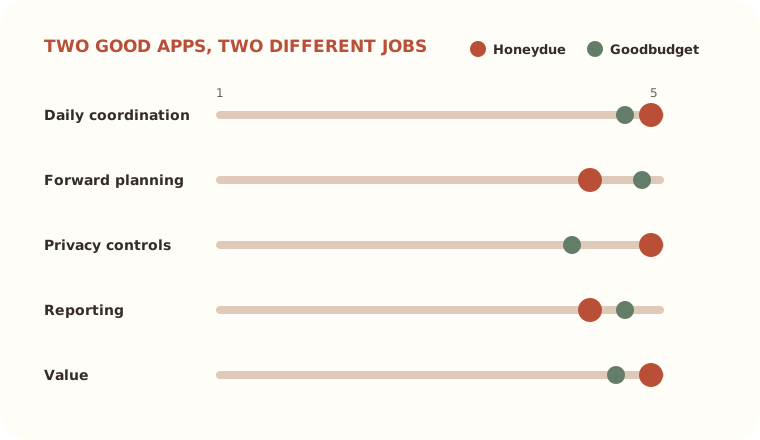
The short comparison
| Category | Honeydue | Goodbudget | Winner |
|---|---|---|---|
| Core approach | Couple account visibility | Digital envelope planning | Tie |
| Free plan | Core sharing and connections | Limited envelopes, 1 account, 2 devices | Honeydue |
| Paid price | No required subscription | $10/month or $80/year | Honeydue |
| Privacy controls | Choose balance and transaction visibility | Shared household budget | Honeydue |
| Forward planning | Basic category budgets and bills | Purpose-built funded envelopes | Goodbudget |
| Platforms | iOS, Android | Web, iOS, Android | Goodbudget |
| Overall score | 4.8/5 | 4.5/5 | Honeydue |
How we compared them
We tested each app for more than four weeks with two adults, separate and joint accounts, bills, groceries, school expenses, and irregular costs. Honeydue ran for 42 days and Goodbudget for 35. We reconciled records and receipts, used iOS and Android, and tested Goodbudget on the web. Priya recalculated every score.
Scores cover daily usefulness, transactions, shared control, planning, and value while respecting each app's purpose. We judged whether each product clarified the next decision and whether both partners kept it current during a busy week.
1. Couple coordination: Honeydue wins
Honeydue is built around two people. Each has a login, connects accounts, and chooses what the other sees. A balance may stay private while selected transactions remain visible. Either person can comment in the shared feed. That supports couples who combine some money without pretending everything is joint.
Goodbudget syncs one household budget across devices. It is excellent when both people want the same envelope plan, but less nuanced with separate accounts or privacy expectations. Goodbudget shares the plan well; Honeydue shares the ongoing conversation better.
2. Budget planning: Goodbudget wins
Goodbudget's envelopes require money to have a purpose before it is spent. You fund groceries, transport, school, gifts, or any other category, then watch the available amount decline. Envelopes can hold money for irregular expenses, which makes the method useful for insurance, holiday gifts, and car maintenance. The design encourages a short household planning meeting instead of passive monitoring.
Honeydue supports category budgets and recurring bills, but planning is lighter. It tells couples what happened and what is coming without creating the same allocation ritual. A household trying to curb spending proactively will get stronger guardrails from Goodbudget. A household that abandons elaborate budgets after one week may get more truth from Honeydue's simpler shared view.
3. Bank connections and daily tracking: Honeydue wins
Honeydue includes linked accounts for free. Most posted transactions appeared reliably, though a credit union lagged twice. The feed, comments, and custom categories connected cleanup to the household discussion.
Goodbudget works manually, through imports, or with Premium U.S. bank sync. Imported activity still needs an envelope because a merchant cannot identify the purpose of a warehouse purchase. Honeydue wins on friction; Goodbudget correctly preserves human judgment.
4. Price and long-term value: Honeydue wins
Honeydue is free as of August 5, 2026, and we encountered no required subscription. Goodbudget's free plan supports a functional small budget but limits account and envelope capacity. Premium costs $10 per month or $80 per year, adding unlimited accounts and regular envelopes, more devices and history, and U.S. bank sync.
Goodbudget can justify $80 if its planning method prevents waste or makes sinking funds routine. Still, this category is not close for couples who simply need account coordination. Honeydue provides more of its best experience at $0. Neither company paid NestPenny, supplied a test account, or reviewed our conclusions.
5. Platforms and deeper reporting: Goodbudget wins
Goodbudget works on web, iOS, and Android. We preferred a laptop for envelope design and month-end review, then phones for entries. Premium history also helps households compare envelopes across years.
Honeydue is mobile-first and has no equivalent desktop workspace. Its reports support household orientation, not deep analysis. Anyone who prefers a keyboard and wide table should count that heavily.
Final decision
Honeydue wins because it asks less while solving a common problem well. Its 4.8/5 reflects excellent sharing, thoughtful visibility controls, dependable tracking, and exceptional value. It is the safer recommendation for partners seeking coordination without a new budgeting identity.
Goodbudget's 4.5/5 is still excellent and may suit committed envelope budgeters better. Read our Goodbudget review and Honeydue review for details. Otherwise, compare four alternatives in our best apps guide or use how to choose an app.
Honeydue vs. Goodbudget FAQ
Which is better for couples, Honeydue or Goodbudget?
Honeydue is better for most couples because each partner can connect accounts, control visibility, and discuss transactions in a shared feed at no required cost. Goodbudget is better when both partners explicitly want an envelope system and will assign money before spending. Our overall scores are 4.8 and 4.5, respectively.
Which app is better without a paid plan?
Honeydue offers the stronger free experience for a multi-account couple. Goodbudget's free tier is useful but limited to one financial account, two devices, and a fixed set of envelopes. Honeydue makes its core account connection and couple-coordination tools free, so fewer households encounter a paywall during ordinary use.
Can Honeydue use envelope budgeting?
Honeydue supports spending categories and budgets, but it does not reproduce Goodbudget's deliberate envelope workflow. Goodbudget asks you to fund purposes before spending and clearly shows what remains in each envelope. You can imitate that discipline in Honeydue, but Goodbudget makes the method central and easier to maintain.
Can we switch from Goodbudget to Honeydue or back?
Yes, but expect setup work rather than a perfect one-click transfer. Export or preserve your existing transaction history first, record current envelope balances, and keep the old account available while the new system completes a pay cycle. Account connections can be rebuilt; custom envelope logic usually needs to be recreated manually.