Data piece · August 5, 2026
The grocery receipt autopsy: 60 days, 4 stores
Twenty-three receipts, one fixed basket, and a winner that survived the waste test.
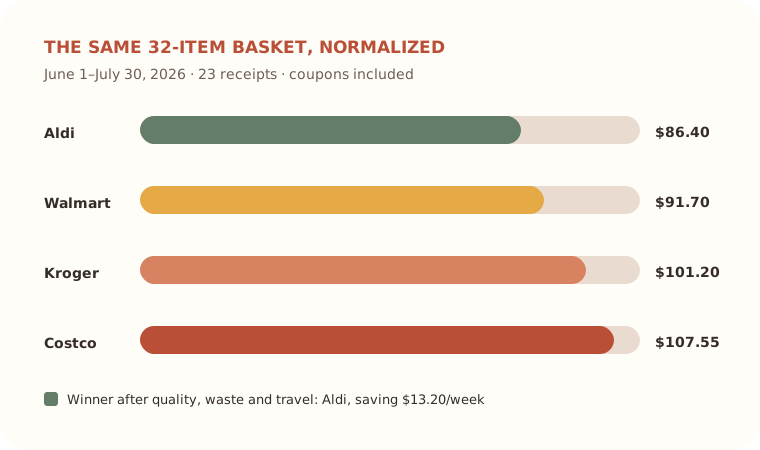
Aldi won our 60-day grocery comparison at a normalized $86.40 per weekly basket. Walmart followed at $91.70, Kroger at $101.20, and Costco at $107.55. After coupons, travel, impulse items, and food waste, Aldi still saved our family an estimated $13.20 a week—about $686 a year at the same pattern.
What we measured
From June 1 through July 30, 2026, Maya and Daniel saved 23 itemized receipts from Aldi, Walmart, Kroger, and Costco. They tagged every line as planned food, substitution, household supply, or unplanned purchase. I normalized a 32-item repeat basket covering milk, eggs, sandwich bread, oats, chicken, ground turkey, rice, pasta, canned tomatoes, yogurt, apples, bananas, frozen vegetables, and other ordinary staples.
Package sizes complicated the comparison. Costco’s two large cereal bags could not fairly compete with one supermarket box, so we calculated the quantity the family typically used in seven days. Coupons and loyalty discounts counted only when actually received. Credit-card rewards did not count because they depended on payment method, not store pricing.
The headline basket was only the beginning
| Store | Normalized basket | Unplanned per visit | Waste estimate | Round-trip time |
|---|---|---|---|---|
| Aldi | $86.40 | $3.10 | $2.80/week | 34 minutes |
| Walmart | $91.70 | $6.45 | $3.25/week | 46 minutes |
| Kroger | $101.20 | $8.70 | $3.60/week | 31 minutes |
| Costco | $107.55 | $18.30 | $8.10/week | 58 minutes |
Aldi’s $5.30 lead over Walmart was smaller than we expected. Its larger advantage was behavioral: fewer aisle-end promotions and less product variety produced only $3.10 in average unplanned spending. The trade-off was inconsistent inventory. Across six visits, at least one basket item was unavailable four times. We priced a replacement from the next planned stop, not a special emergency trip.
Walmart was the practical second. It won on pantry breadth and had the lowest price on eleven individual items, but it lost the full basket on produce, dairy, and two meat staples. Pickup could change the time result and reduce impulse buys; we tested in-store shopping because that was the household’s normal routine.
Kroger’s coupons did real work, but not enough
Kroger’s shelf prices produced the highest supermarket total before discounts. Digital coupons and loyalty pricing removed an average $11.84 per visit, bringing the normalized basket to $101.20. That is a meaningful saving, not fake math, but it required checking the app and buying around the promotion cycle. Without clipped offers, the same basket averaged $108.90.
Kroger was fastest because it was closest and familiar. That matters. Valuing time at even $10 an hour erases part of Aldi’s advantage for a household driving far out of its way. Our Aldi added only three round-trip minutes compared with Kroger, so the price result survived. A reader 25 minutes from Aldi should expect a different answer.
Why Costco lost this particular test
Costco had excellent unit prices for oats, olive oil, frozen berries, nuts, and rotisserie chicken. It lost because a family budget pays the register total and later absorbs waste. Large salad greens, bakery bread, and produce packages exceeded our four-person consumption in three weeks. We estimated waste at purchase price, using only food visibly discarded—not theoretical spoilage.
Costco also generated $18.30 in average unplanned purchases per visit, mainly snacks and seasonal household goods. That is a household behavior, not a flaw in the store. A disciplined shopper with freezer space may reverse the result. Our evidence says bulk shopping is a storage-and-habit strategy, not an automatic discount.
The winner and the new routine
We chose Aldi for the weekly base shop, with a short Walmart pickup every two weeks for six items Aldi did not reliably stock. Costco remains a planned monthly stop for five products with proven turnover. Kroger is the emergency option because proximity sometimes beats a perfect unit price.
This hybrid plan projects $109 less spending across the next eight weeks than repeating our old Costco-and-Kroger pattern. We will check it against actual receipts, not congratulate ourselves in advance. Our finance glossary explains cash flow and variable expenses, while the budget-app guide shows how to test category rules and imports. For shared purchase context, our Honeydue review includes the exact transaction-note workflow the household used.
How to perform your own receipt autopsy
Pick 20 to 30 items your household buys repeatedly. Keep eight weeks of itemized receipts, record package size and price after discounts, and calculate a comparable household quantity. Add separate columns for travel time, unplanned purchases, substitutions, and discarded food. Do not crown a winner from one promotional week.
The useful question is not “Which chain is cheapest?” It is “Which shopping routine produces the lowest usable-food cost for this household?” Our answer was Aldi plus a small Walmart supplement. Another pantry, freezer, diet, or commute can produce a different winner from equally honest arithmetic.
FAQ
Which grocery store was cheapest in our test?
Aldi had the lowest normalized basket at $86.40 and remained the winner after we included waste, travel, and impulse purchases.
Why was Costco the most expensive basket?
Unit prices were often competitive, but package sizes caused more spending and more waste for our family of four. Bulk value depends on storage and actual consumption.
How can a household run the same grocery test?
Choose 20 to 30 repeat items, record unit sizes and discounts for six to eight weeks, and separate planned food from impulse and household purchases.