Household diary · August 5, 2026
Family of four, one app: our Honeydue experiment
Eight weeks, 714 transactions, three genuine arguments, and one habit worth keeping.
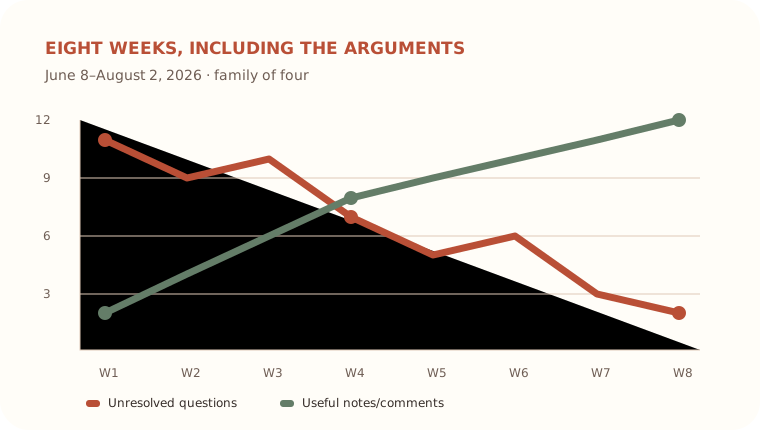
Honeydue made our family finances easier to explain, not automatically easier to agree on. From June 8 through August 2, 2026, it cut our unresolved weekly money questions from eleven to two. We kept shared transaction notes and Sunday check-ins; we dropped noisy alerts and the fiction that every purchase needed joint approval.
Week 1: the setup looked suspiciously easy
On June 8, Daniel and I connected household checking, two credit cards, savings, and our separate everyday cards. The children, ages eight and eleven, did not receive profiles—Honeydue is fundamentally built for two adults. Instead, we created School, Kids’ Activities, Groceries, and Allowance categories. I shared my personal card’s transactions but hid its balance; Daniel shared only transactions he marked household. The arrangement took 18 minutes.
Then the alerts arrived. A Saturday with fuel, a pharmacy stop, two grocery trips, and a refunded camp deposit produced enough notifications to make shared visibility feel like surveillance. On June 12 we disabled most transaction alerts and kept bill reminders. That decision mattered more than any category choice.
Weeks 2–3: the fights were about definitions
Our first argument was a $63.40 warehouse-store trip. Daniel saw “Groceries”; I saw sunscreen, printer paper, and food. The app was correct that money left the account and useless at deciding what it meant. We split the transaction and added one note. The task took two minutes; the conversation about whether household supplies belonged inside groceries took twelve.
The second argument arrived June 24, when a $145 soccer registration appeared after we had discussed “about $100.” The problem was not secret spending. Tax, a uniform charge, and vague memory had widened the number. A receipt photo would have helped, but a note listing the three pieces was enough. We created a rule: any child expense more than $75 gets a short note on the same day.
| Measure | Weeks 1–2 | Weeks 7–8 | Result |
|---|---|---|---|
| Unresolved questions at Sunday check-in | 11 per week | 2 per week | Down 82% |
| Useful notes or comments | 3 per week | 12 per week | Context moved into the feed |
| Category corrections | 17 per week | 6 per week | Custom rules began working |
| Meeting length | 31 minutes | 14 minutes | Facts required less reconstruction |
| App cost | $0 | $0 | No subscription required |
Weeks 4–5: one person quietly did the work
By July 5, our shared feed looked orderly because I was correcting nearly everything. That is a common household-systems trap: software appears collaborative while one adult supplies the maintenance. I stopped correcting Daniel’s categories for seven days. The result was untidy, but useful. He found three recurring errors and created rules himself; I learned that two imperfect category systems were better than one perfect system owned by me.
Our third fight was the most revealing. I described a $38 craft-store purchase as “for the kids.” Daniel remembered unused supplies in a closet. Honeydue supplied the transaction, category, date, and comment box. None answered whether the purchase was worthwhile. We parked the decision until Sunday, checked the activity budget, and returned $16 of duplicate materials. An app can hold evidence. It cannot manufacture a shared priority.
Weeks 6–8: the app became boring
Boring was the win. From July 13 onward, neither of us opened Honeydue for entertainment or cleanup theater. We checked upcoming bills on Sunday, commented when a transaction needed context, and otherwise left it alone. In week eight, 96 of 101 transactions required no action. Two needed category changes, two got explanatory notes, and one restaurant charge was a duplicate pending item that disappeared.
The experiment also clarified Honeydue’s boundary. It is better at shared awareness than forward allocation. When September school costs approached, we used a separate sinking-fund number because Honeydue’s planning layer did not give us the envelope discipline we wanted. Our Goodbudget review explains the stronger planning alternative, while the full 42-day Honeydue review covers account connections, privacy controls, and scoring.
What we kept after August 2
We kept five categories, not twenty-three; notes above the $75 child-expense threshold; bill reminders; and a weekly meeting capped at fifteen minutes. We also kept separate visibility choices. Shared household money does not require identical access to every personal balance.
We stopped reacting to ordinary purchases, policing categories midweek, and treating the transaction feed as a verdict. For couples choosing between tools, our Honeydue versus Goodbudget comparison is the cleaner feature decision. For us, Honeydue stayed because it shortened the factual part of money conversations and left more time for the human part.
FAQ
Can children have profiles in Honeydue?
Honeydue is designed around two adult partners, not a four-person family account. We tracked child-related spending through categories and notes rather than giving our children logins.
Did Honeydue stop money arguments?
No. It reduced factual confusion and repeated questions, but it could not decide what counted as a household expense or whether an activity was worth its price.
How long should a couple test Honeydue?
Use it through at least one full pay cycle; four weeks is better. Our strongest habits appeared in weeks five through eight, after notifications and categories were simplified.